How to Set Net Promoter Score® Targets For Your Staff and Company
Once NPS data is flowing, the question of targets follows almost immediately. Set them badly and you'll get score-begging, gaming and demotivated staff. Here's a practical approach to setting NPS targets: the prerequisites, local targets vs global targets, and why you should wait longer than feels comfortable before setting any at all.

On this page
Almost immediately after you have established your Net Promoter Score (NPS®) process and started collecting data, the question of setting targets for the business and individual staff arises.
Because of course, as the great management guru Peter Drucker is erroneously attributed as saying:
“What gets measured, gets done.”
But also:
“The basic rule on incentives is you get what you were rewarded for, so if you have a dumb incentive system, you get dumb outcomes.”
So before setting your NPS targets you need to be careful to set them in a way that supports the overall goals of the organisation. Poorly set targets will contribute to staff de-motivation, “score-begging” and other negative outcomes.
In this post I’ll provide a practical approach to setting Net Promoter targets for your organisation and staff.
Most target-setting guidance treats this as a scorecard exercise. Set a number, cascade it to each team or region, and put a slice of pay against it.
That gets a number onto every dashboard fast. It also hands the front line exactly the incentive to score-beg instead of fix anything, which is the trap that giving staff individual Net Promoter targets sets every time.
The approach below avoids that trap: wait longer than feels comfortable, set targets at the largest group you reasonably can, and never hand an individual or small team their own number.
Prerequisites For Setting Net Promoter Targets
Before setting targets you must ensure that the data you collect is consistent, reliable and well understood by staff.
People Must Trust the Measurement System
In simple terms, people need to believe the system delivering the measurement is accurate otherwise they will refuse to be held accountable.
For this reason you need to ensure you have a stable, repeatable Net Promoter measurement system and everyone knows how it operates.
Importantly, it’s not just the data collection system that needs to be consistent but also the survey methodology, when and who you survey.
Your process does not have to use any specific medium or survey questionnaire; just make sure that you don’t compare results from different mediums, survey questionnaires, customer segments, countries, etc.
This is critical because the survey approach and type can affect the score. Comparing last month’s email survey results to this month’s telephone results is not valid.
Actively Prevent Gaming of NPS Data
When building your data collection system try to ensure that it cannot be easily “gamed” by staff. If staff know the system can be gamed, and they will share this information quickly amongst themselves, they will lack confidence in the results.
For instance having staff select, directly or indirectly, who will be surveyed is open to abuse. It’s no accident that when contact details are updated, the email addresses of unhappy customers are mis-entered more often than those of happy customers.
Also look out for situations where the process can be manipulated by unscrupulous employees.
Design out, as much as is possible, these situations so that everyone has confidence in the system.
Remember that the process must not only be fair but it must also be seen to be fair.
As with any new system it may take several months, or even longer, to build trust in the measurements. Don’t try to set targets before you have this basic element of trust in place. If staff do not trust the score, they will not be motivated by the score.
Understand the Statistical Error Present in NPS Data
All systems that rely on data sampling, including NPS surveys, are subject to sampling error. Most people have heard of terms such as “margin of error”, “confidence intervals”, etc.
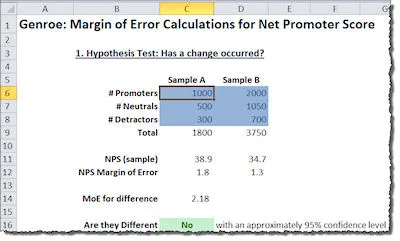
Testing whether a change in Net Promoter Score is real or just sampling noise
You must ensure that staff understand which Net Promoter Score variations constitute “real” change in the underlying score and which are probably just statistical noise.
See this post for more information on the science of Net Promoter statistical analysis: How to calculate NPS® Margin of Error and other Statistics (Excel Download)
Ensure Staff Can Impact Outcomes
People need to believe they can impact on the thing being measured or they will not be motivated. For Net Promoter this means staff must know what they can do to affect the Net Promoter score.
In essence you must perform ongoing root cause analysis to identify explicit cause and effect linkages between NPS and each person’s area of responsibility.
This is not a trivial exercise but is critical in driving staff engagement in the Net Promoter process.
If as an organisation you do not know what is driving NPS, then you will not be able to methodically drive positive change in the score. Your NPS targets will be nothing more than lotteries.
Additionally, there are two types of NPS survey approach: Relationship and Transactional.
The data from Transactional surveys is typically more directly actionable as they can tie action back to a specific transaction type or process and so the root cause analysis can be much easier.
In this case study, How AccessPay Lifted NPS from 15 to 53 in 2 Years, the organisation doesn’t goal staff on the NPS at all. Instead they goal staff on areas they can directly change, e.g. speed of answer, coaching. These areas were identified early on as being important drivers of NPS.
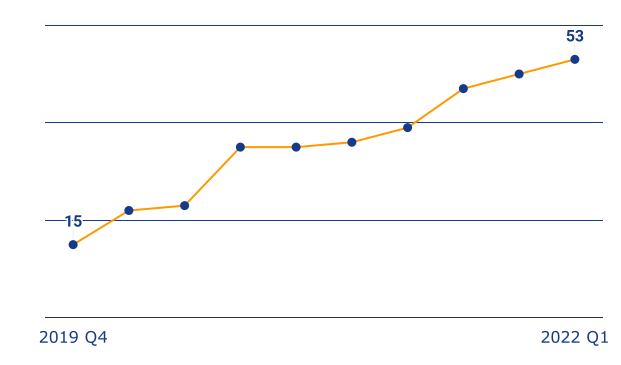
AccessPay’s NPS, 15 to 53, by goaling staff on the drivers rather than the score
Zip Water used the same approach, focusing on drivers, and lifted their score from +2 to +73 with real changes in their business that also lowered costs.
So when reviewing your goal setting worksheet, search for goals that link to the drivers of NPS whenever possible.
Setting Net Promoter Targets
Wait as Long as Possible Before Setting Targets
As soon as the first results are published people will start asking “what should our NPS target be” but you should wait as long as possible before setting that target. If you can, wait 6 months or even 12 months.
Here is why you should wait as long as possible:
Seasonal Swings Can Inflate Your Starting Score
Many, most even, organisations face substantial seasonality in their scores which can extend to a full 12 month cycle.
If you set the goal in a part of the year when you have a naturally high score you will struggle to meet targets set against it on an annual basis.
Early Gains Come Slower and Smaller Than Expected
Seeing the first couple of reports showing a score of 15, 30 or 40, the natural management response is to stake a claim at “5, 10 or 20 point improvements in the next three months”.
Initially, gains take longer to appear than expected and are smaller than expected. Waiting a few months allows you to better estimate the size and timing of business improvement opportunities.
Set Local Not Global NPS Targets
There are many cultural and industry factors that affect the Net Promoter Score a company receives. Scores typically vary between countries, industries and even business models, e.g. product sales vs service sales.
It’s the same reason comparing your score against an external industry benchmark rarely holds up: survey method and sample differences between companies swamp any real gap.
To counter this, set targets at a “local” level, whatever local means in your circumstance. In a global company, this means not giving each operating country the same target. In a national company, this means not giving every operating division the same target.
Never Give Front Line Staff Personal or Small Team NPS Targets
There is often a desire by management to give NPS targets to front line staff in the mistaken belief that it drives positive behaviours.
In practice, it is much easier for a front line staff member to simply ask the customer to provide a good score than: change prices, stock levels, computer systems, training, company policies, staffing levels, etc., etc., etc.
This “score begging” is corrosive to the entire NPS process and customer experience and is examined in detail in this post: It’s time to stop giving people Net Promoter Score targets

NPS Score Begging in a Hotel
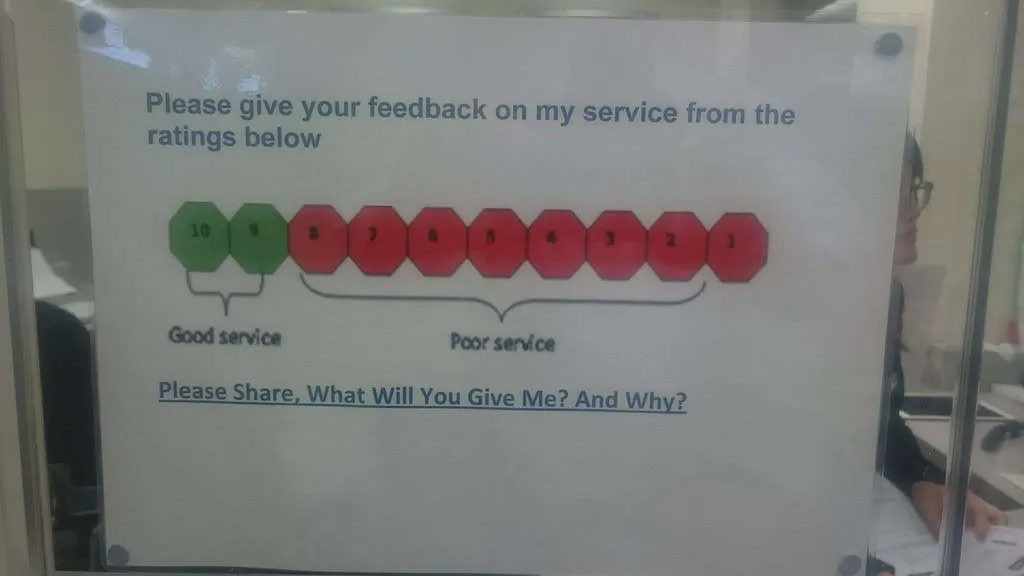
NPS Score Begging in a Bank
This approach is backed up by the co-inventor of NPS, Fred Reichheld, speaking on CustomerGauge’s Account Experience podcast:
“When you link that promoter score to someone’s bonus, anywhere near the front line… it’s a waste of the customer’s time. It’s a waste of the employees’ time. It diminishes the credibility of Net Promoter, and you know it’s just bad.”
Give Organisation Wide Net Promoter Targets
Set your NPS targets at the largest organisation level that you possibly can, while addressing the Set Local Not Global NPS Targets issue.
By giving groups of people the same goal you help generate the cross-functional focus that is needed for most customer experience improvement projects to succeed.
Instead of working against each other in a perceived zero-sum game, staff are likely to work together to improve the entire organisation. Groups/staff with lower local scores will ask for assistance from their peers who are performing better in order to lift the entire organisational score.
Use Relative Change Targets
Absolute Net Promoter Scores have no meaning. Only relative changes in scores over time or between companies have any importance.
We know from the Net Promoter research that if your score goes up, then your revenue will probably go up. This is the whole basis for using Net Promoter as a proxy measure for customer loyalty.
This is also one of the other reasons that running a stable, repeatable measurement process is so important. Cultural and other factors that may skew your overall Net Promoter result are less important if you run a consistent process because the skewing cancels out when looked at on a relative basis.
The starting point for setting targets using relative scores is to look at history.
What has the score been in the last few months?
Once you have a handle on the starting point there are several ways to set relative targets. The three that I like to use the most are:
Set Reasonable Improvement Rates
Generally the lower the current score the easier it will be to improve.
As this chart from “The Ultimate Question 2.0” indicates, the lower the NPS, the greater the opportunity for improvement.
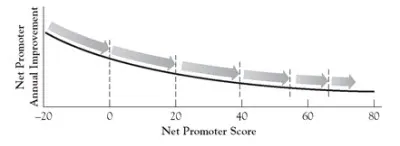
Annual NPS improvement against starting score, from “The Ultimate Question 2.0”
Using this approach, different business units or groups within the organisation may have different “relative change” goals. Those with higher scores have less headroom and so can expect a smaller change. Those with lower scores have more opportunity for improvement.
Target Statistically Significant Improvement
Harking back to the point that you need to know clearly when a movement in the score is real and when it might be statistical chance, another goal setting approach is to look for “significant improvement”.
This “significant” is in the statistical sense, i.e. you are confident that the change is real. The goal for a particular part of the organisation may be simply to create a significant improvement in Net Promoter Score.
If you want to check for statistical significance in your Net Promoter numbers download our free Net Promoter® Comparison Tester.
Target Promoters, Passives or Detractors Directly
There are several mathematical ways to improve a Net Promoter Score:
- move Detractors to Passives,
- move Passives to Promoters,
- move Detractors to Promoters.
Another goaling approach is to select one of these and make that the goal.
So instead of the goal being to change NPS itself, the goal may be to, say, reduce Detractors by 5%, or increase Promoters by 5%, or halve the number of 0s and 1s. You can even flip these goals back and forth on a regular basis.
This is another way to target the way the organisation is focused.
Focusing on halving the very low scores is, for instance, a focus on fixing serious process and service or product quality issues.
Focusing on improving the number of Promoters is a focus on pulling ahead of your industry in key areas.
How Much Improvement Is Possible?
A realistic first-year target depends on where you’re starting from. Strategex’s rule of thumb puts it at 15 to 20 points from a low or negative baseline, around 10 points from an average-to-good score (15 to 40), and a modest 5 points, or simply holding level, once you’re already above 50. Treat that as a starting point, not a target in itself: your own history and industry matter more than any external rule of thumb.
For real company results instead of a rule of thumb, see Net Promoter Score: How Much Can You Improve – Real Company Data.
Next Steps
Setting the target is the easy part. Most of the NPS programmes I review have a number on a dashboard and no clear link between that number and what the business actually changed to move it. If you want a second opinion on whether your target-setting approach will hold up under gaming and seasonality, I’m happy to talk it through.
Frequently Asked Questions
How Long Should You Wait Before Setting an NPS Target?
- Wait at least six months, and twelve if you can manage it. Many organisations show seasonal NPS swings across a full year, so an early target risks locking in a naturally high score as the baseline. Early improvement estimates are mostly too optimistic: gains typically arrive slower and smaller than the first few reports suggest.
Should Front Line Staff Have Individual NPS Targets?
- No. Front line staff control very little of what actually drives NPS: pricing, systems, policy and training are set elsewhere. Handing them a personal target mostly produces score-begging rather than better service, which is why NPS co-inventor Fred Reichheld advises against tying the score to individual pay or bonuses.
Should NPS Targets Be Absolute or Relative?
- Relative. An absolute Net Promoter Score has no standalone meaning: only the change over time, measured with a consistent survey process, tells you anything useful. Compare this quarter’s or year’s score against your own history rather than chasing a specific number like 50 or 70.
What’s a Realistic NPS Improvement Target?
- It depends on your starting point. One rule of thumb puts it at 15 to 20 points from a low or negative baseline, around 10 points from an average-to-good score, and a modest 5 points once you’re already above 50. Treat it as a planning input, not a guarantee.