It’s time to stop giving people Net Promoter Score® targets
Search for how to set NPS targets and the internet is near-unanimous: set SMART goals, cascade them to teams, put a slice in the bonus. Half of CX teams do exactly that. In our experience it backfires; the score gets gamed, intrinsic motivation dies, and the customer experience quietly gets worse. Here’s the evidence, and the approach that actually moves the number.

On this page
Search for “how to set NPS targets” and the advice is remarkably consistent. Make them SMART. Cascade them from the company down to the team, and ideally the individual.
Then put a slice of the bonus on the number so people take it seriously. Forrester found about half of CX leaders now pay employees for hitting NPS targets, so this is the rule not the exception.
Some of that advice is fine. Building trust in the programme before you set goals, keeping goals directional (“trending up”) rather than fixed, aiming reduce detractors rather than chase a decimal point, setting the target at the largest group level you can; all sensible.
But the core of the mainstream advice, hand individuals and front line staff a Net Promoter® number and reward them for hitting it, is after 20+ years of running these programmes, the single fastest way we know to quietly wreck an NPS programme.
It is counter-productive at best and damaging at worst. Here’s why.
It destroys intrinsic motivation
When paid to perform a task they naturally enjoyed, people did less of it. Talk about counter-intuitive.
When money is used as an external reward for some activity the subjects lose intrinsic interest for the activity.” Edward Deci
In his research, Deci examined how offering a reward for completing a task (a puzzle) affected people’s motivation. He found that subjects who had happily worked on a puzzle for no reward lost interest once a reward was introduced and was then taken away.
The same thing happens to your front line if you add an extrinsic reward for Net Promoter Scores: you destroy their intrinsic motivation to provide good service. All of a sudden good service is only something they provide if they get a direct reward.
Most of the score is out of front line control
It’s often easier to distort the system or the numbers than it is to actually improve. Mark Graban
Think about a front line person in a bank.
Their rules come from compliance.
Their competency comes from the training the company gave them.
Their tools, systems and décor are chosen by someone else.
Even their temperament was pre-selected in the hiring process.
There is very little they can personally do to move a customer’s overall perception; they can smile and be pleasant, and that’s about it.
So when you put NPS on their scorecard, you’ve set a target they have very little control over. There’s only one lever left: score-beg.

Image credit: Rob Markey
That doesn’t help the business and it scales badly.
Fred Reichheld, the man who co-created NPS, warns that tying the score to pay reliably produces gaming at every level.
Exploding the Myths
The usual justifications for individual NPS targets don’t survive contact with the evidence. This matrix from Gartner neatly explodes them:
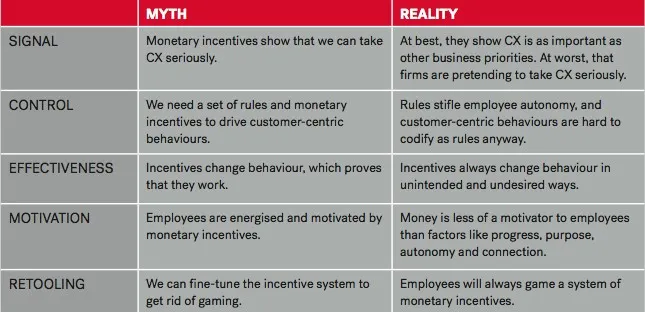
Source: Forrester mythbusters explain why incentivising CX never works
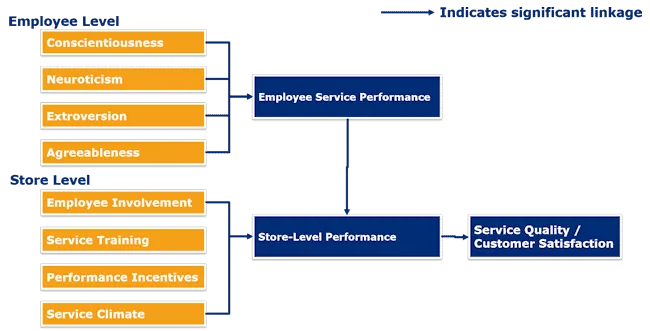
And in this study of what actually drives service quality in retail, the significant factors were Service Climate and Employee Involvement.
Performance incentives? No measurable link to service quality at all.
What to do instead
Make NPS a key metric, not a bonus lever
Report it, watch it, talk about it but don’t put it in the pay packet.
One of our clients described the moment NPS came off the senior leadership KPI list: instead of quietly dying, the programme got better, because people finally stopped defending a number and started using the data to decide what to change.
When the score isn’t the prize, the insight becomes the prize.
Remember the score itself is close to worthless
Knowing you’re a 42 tells you nothing you can act on.
The value is in the drivers; what customers care about most, where you’re under-delivering, and in picking the one or two things to fix in the next 12 months.
That’s a diagnosis, not a scoreboard.
Involve people and fix root causes
Toyota and the quality movement solved this decades ago: the way you lift a quality score is to involve the people doing the work. Teach the front line simple root cause analysis, ask for their ideas, and give them a structured way to follow up.
Case study evidence that having no target works
BPH
BHP ran exactly this play in their Western Australian iron ore operations; around 1,860 improvement initiatives in a single year, reviewed weekly in a “war room”.
Crucially: “There are no monetary rewards for offered ideas.” Source
As Edgar Basto, head of BHP’s Western Australian iron ore operations, put it:
What I have seen with this is that if you pay attention, if you listen to the guys, you energise them so they can come up with new ideas.
In fact, people perform worse on creative problems when you dangle a reward for them. The classic candle problem showed exactly that.
Imagine 400 ideas to improve your customer experience next month, none of them bought with a bonus.
Manheim
When Manheim implemented NPS, marketing director Justin Hodgson told me:
We had a goal of 2 improvement projects in the first year and we have 17 already… [Our Managing Director] recently said this was the best project the company has implemented this year… Our staff are really taking this seriously…
In that entire one hour webinar conversation, do you know what he barely mentioned? The score.
His focus was almost entirely on how the feedback was driving improvement projects; not on who hit or missed a number.
CyberCX
We saw the same at CyberCX. Very early in their programme, COO Tom Allan agreed to avoid giving the consulting teams individual NPS targets and the programme has thrived precisely because it stayed a learning tool rather than a stick.
If you’re weighing whether to put NPS on someone’s scorecard, it’s worth a conversation before you do; we’ll give you the honest version, including where we’d tell you not to bother.


![[Case Study] How AccessPay Lifted NPS from 15 to 53 in 2 Years](/_astro/accesspay-nps-chart.D6s0WUCj.svg)